
The AI Hypocrisy
What the tabletop RPG industry is actually doing while saying it isn't

Earlier this year, the Tabletop Game Designers Association surveyed 171 game designers about their use of generative AI. Over half said they had used it in their work. Roughly a quarter of those described themselves as "strongly opposed" to AI in public.
At the UK Games Expo in 2026, a panel moderated by Evie Moriarty, Lead Game Designer at Modiphius, gave this phenomenon a name. They called it "Shadow AI": creators using AI tools in secret, driven by what the panelists described as deep professional embarrassment or fear of public cancellation. The secrecy, the panel concluded, is actively poisoning peer-to-peer relationships in the industry.
This article is about the gap between what the tabletop RPG industry says about AI and what it actually does. The public stance is easy to map. What's behind it takes more digging.
The wall
The tabletop RPG industry has the most unified anti-AI public stance of any entertainment sector. A short, incomplete list:
Foundry VTT's founder calls generative AI "an exploitative technology" and says adopting it would be "a betrayal." Asked if Foundry would ever use AI: "No." Foundry has a compliance deadline of September 14, 2026, a voluntary "Zero AI" badge for community packages, and an explicit ban on "vibe coding."
Paizo requires contractually that all work be human-made. Chaosium banned AI from its community content programs in late 2022. Kobold Press has a formal "No AI Pledge." Free League says AI art "is and will not be used." Modiphius forbids AI assets in its World Builders program. Evil Hat: "We do not use AI. Period."
On the convention floor, Gen Con bans AI art from its Art Show. At Dragon Con in 2025, a vendor was escorted out by police for selling AI-generated art. On the crowdfunding side, BackerKit requires that "all content must first be created by humans."
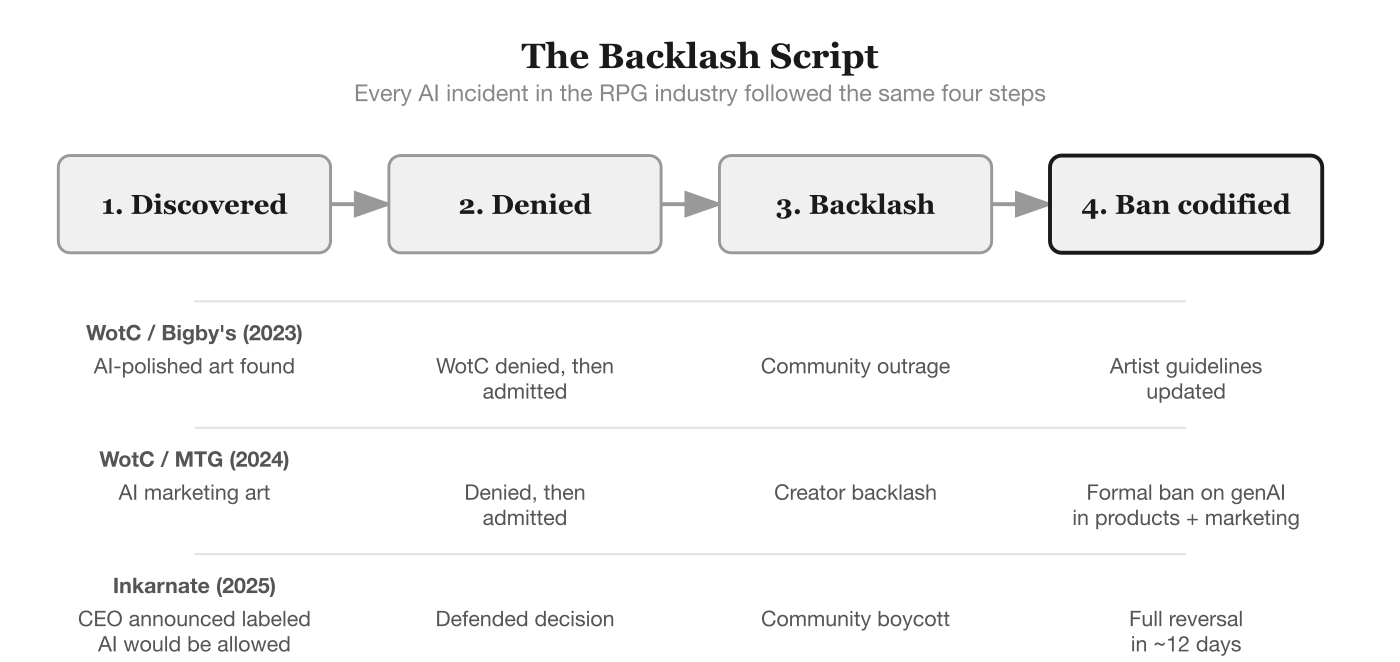
Every anti-AI incident in the industry has followed the same script: AI use is discovered. The company denies or defends it. The community erupts. A ban is codified. This happened with Wizards of the Coast in 2023, again in 2024, with Roll20 and DriveThruRPG in 2023, and with Inkarnate in 2025, where a community boycott forced a full reversal in roughly twelve days.
The ENnie Awards now have a total ban on generative AI. "No AI" has become a marketing differentiator.
From the outside, you would reasonably conclude that the industry has firmly decided. AI is out.
The board chairman

Roll20 is the largest virtual tabletop platform. Together with DriveThruRPG, DMs Guild, Demiplane, and Dungeon Scrawl, it forms an ecosystem that touches a significant share of the hobby. Roll20 banned AI art from its marketplace in March 2023 and AI text in July 2023. Enforcement is honor-system. Content moderation is "largely manual." Dungeon Scrawl is marketed as "0% AI." No executive has ever discussed AI publicly in a podcast, conference talk, or interview. The AI content bans were communicated through unsigned corporate blog posts.
Riley Dutton co-founded Roll20. He is its Board Chairman. He is also simultaneously building Kitbash, an AI-powered game engine that uses Claude to generate game content, through the a16z Speedrun accelerator. Kitbash and Roll20 are separate companies, and a marketplace content policy is a different question than AI-assisted game creation. But the co-founder of Roll20 and a member of its board is actively building AI gaming products through one of Silicon Valley's top accelerators, and nobody at Roll20 has ever been asked about this in a format where follow-up questions could be asked.
Roll20's CEO, Ankit Lal, teaches Data Science and Machine Learning at Columbia University's pre-college programs. He taught the course as recently as July 2026, while this research was being conducted. He has an MA in Applied Statistics from Columbia and was formerly Lead of Product Strategy & Insights at Google Workspace. In his only substantive Roll20 interview, he made no mention of AI.
Roll20's Director of Software Engineering has a personal GitHub repository whose README describes it as "a single-file artifact generated in a Claude.ai chat."
None of them has publicly connected their AI work to their company role, and nobody has asked them to.
The codebase
Roll20's newest repository, Beacon sheets, is the codebase behind its next-generation character sheets. It's open source, built by a mix of Roll20 employees and community volunteers. Thirty-one commits on its main branch carry Claude co-author tags. A production-grade 350-line Claude Code configuration file sits in the repo. One pull request, for a character sheet built entirely with Claude's autonomous coding mode, was closed without merge, but with no stated objection to the AI methodology.
Roll20 has no policy on AI-assisted code contributions. No mention in any contributing guidelines, no PR template fields, no guardrails. AI-authored commits go in, get reviewed by CodeRabbit (an AI code review bot), and ship to users. If you play AGE System games on Roll20, like Dragon Age or The Expanse, you are running code co-authored by Claude right now.
Meanwhile, Roll20's Director of Operations wrote in the original AI ban announcement:
"Policies limiting AI-generated art will over time prove unsustainable."
The CEO

Chris Cocks is the CEO of Hasbro, the parent company of Wizards of the Coast, which makes Dungeons & Dragons and Magic: The Gathering.
In September 2024, at the Goldman Sachs Communacopia conference, he said "all my friends use AI" for their D&D games and called it "a clear signal that we need to be embracing it." In a March 2025 interview with Semafor, he called himself an "AI bull."
In February 2026, on an earnings call, he said internal AI use had been "a clear success," projecting "more than 1 million hours of lower-value work" freed across the company.
In March 2026, speaking to The Verge, he said generative AI is "not in our pipelines for our video games or for Magic: The Gathering or D&D." The audience, the creators, he said, "just don't want it." "Garbage in, garbage out." In the same interview, he admitted his laptop is full of AI-generated D&D assets.
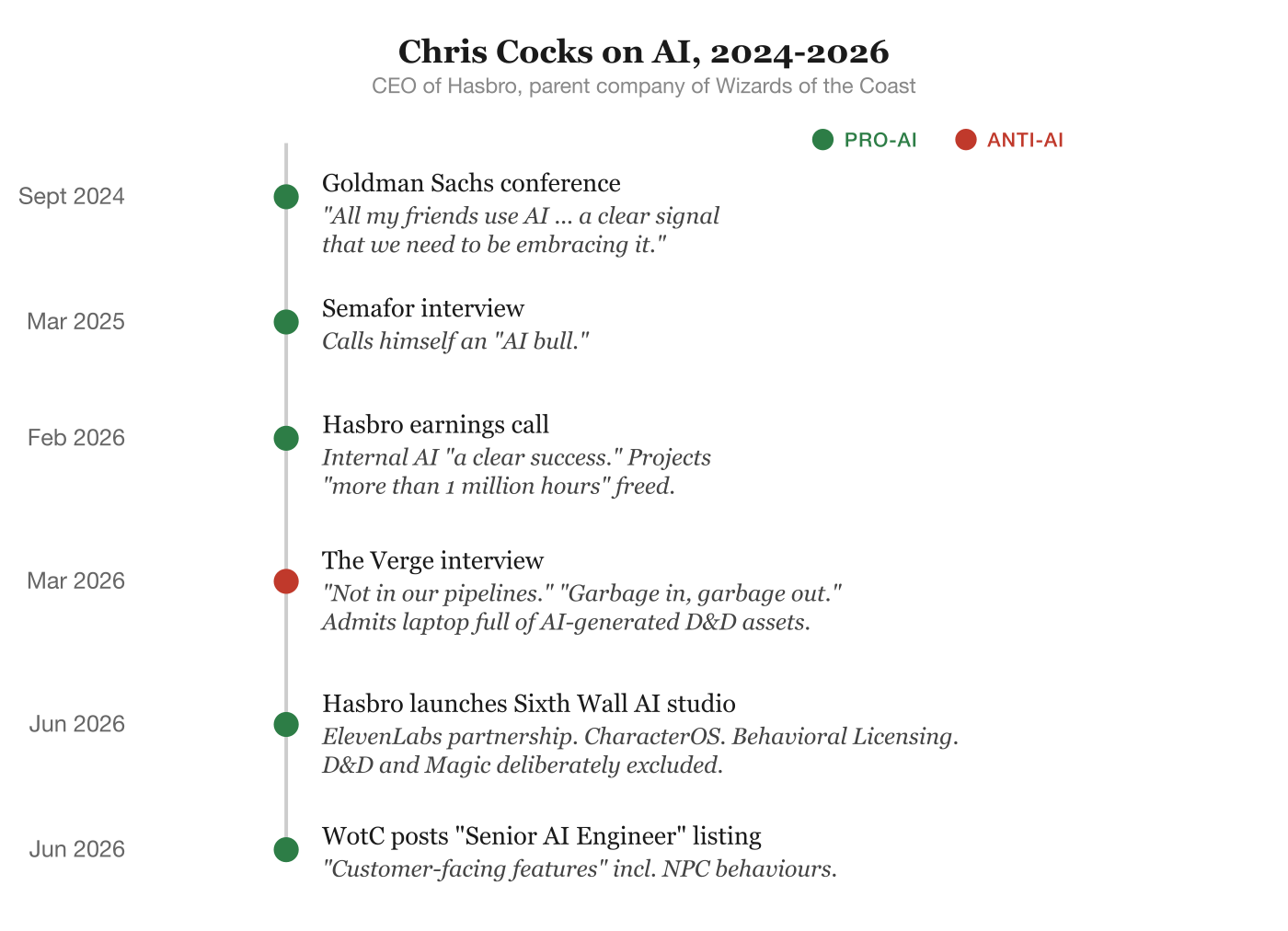
In June 2026, Hasbro launched Sixth Wall, an in-house AI studio with an ElevenLabs partnership, a new "Behavioral Licensing" category, and a technology called CharacterOS that encodes character personality, emotional range, and safety guardrails into AI. Transformers, G.I. Joe, Monopoly, and Clue are in. D&D and Magic are deliberately excluded from the launch. When Wargamer asked WotC about this directly, they got no response.
Also in June 2026, WotC posted a job listing for a "Senior AI Engineer" for "customer-facing features" including "player assistance, tutorials, NPC behaviours."
Each of these statements was made by the same person within eighteen months.
The one who said it out loud

Ryan Dancey helped negotiate the sale of TSR to Wizards of the Coast. He created the Open Gaming License, the legal framework that made the d20 ecosystem possible. He spent thirty years in the RPG industry.
In February 2026, as COO of Alderac Entertainment Group, he said publicly that AI could generate game ideas as good as AEG's titles. He was out of the company shortly after.
A handful of industry figures spoke up. Robert Kuntz, one of the original D&D co-creators, told critics to "lighten up." Darwin Kastle and Rob Dougherty, both Magic: The Gathering Hall of Famers, defended AI as "an artist's tool." All of them were retired or independent. None of them had a job to lose.
Over half of surveyed game designers are using AI. One of them said so publicly. He's the one who lost his job.
What's selling
DriveThruRPG, the platform that bans AI-generated text and art, requires AI disclosure on every product uploaded since 2023. A scan of the platform's public API in July 2026 returned roughly 17,400 AI-tagged products.
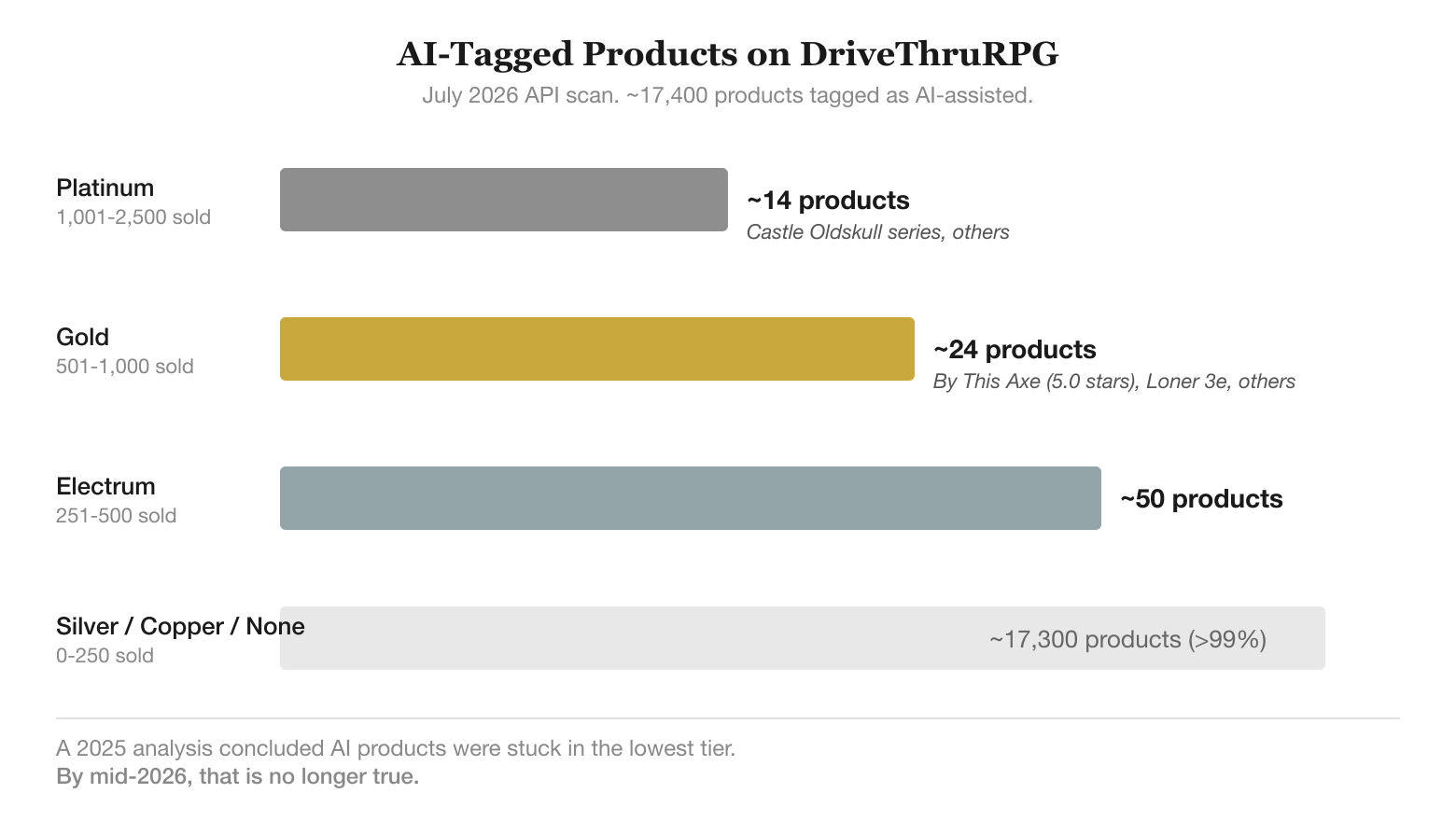
Most sit in the lowest sales tiers. But around fourteen have reached Platinum, meaning over a thousand copies sold. Twenty-four have reached Gold. Fifty have reached Electrum. Some carry near-perfect review scores: By This Axe: Cyclopedia by Autarch averages 5.0 across 42 reviews. These are products that disclosed AI use somewhere in their workflow and sold thousands of copies anyway.A widely cited 2025 analysis by Geek Native concluded that AI-tagged products were stuck in DriveThruRPG's lowest sales tier. By mid-2026, that is no longer true.
And then there's the publisher ID problem. DriveThruRPG's community content programs publish all products under the IP holder's account. When an independent creator submits AI-tagged content to the Jonstown Compendium or the Free League Workshop, it appears on the platform under Chaosium's or Free League's name.
Free League, which says AI art "is and will not be used" in its products, has no AI policy at all for its Workshop platform. Nine or more AI-tagged products sit under Free League's publisher ID on DriveThruRPG right now.
Chaosium has at least five AI-tagged products under its publisher account, all Jonstown Compendium community content, most published before its March 2023 ban. Meanwhile, Chaosium has officially partnered with Quest Portal to launch "Elder," an AI chatbot trained on Call of Cthulhu rulebooks, at five dollars a month.
The outlier
There is one company that didn't follow the script. SmiteWorks, the company behind Fantasy Grounds, openly embraced AI-generated content. Its president, Doug Davison, personally created portrait packs using Stable Diffusion and sold them on the Fantasy Grounds Forge.
The community reaction was moderate, not explosive. Forum threads requested opt-out options. Ratings hovered around 4.2 stars. Davison's personal ownership of the decision made it harder to frame as faceless corporate exploitation. No crisis materialized.
SmiteWorks later shifted its tool choices toward DALL-E and Adobe Photoshop AI, positioning them as more ethically defensible. Third-party creators continue to sell AI-generated content on the Forge with no visible enforcement of labeling. Fantasy Grounds itself has no native AI features.
The one company whose leader put his name on AI use, personally and without deflection, is the one that survived the backlash without a ban. The companies that communicated their bans through unsigned blog posts have never put a face on the policy.
Where this leaves us
A UK Games Expo panelist described the cost of all this:
"The mere fear of AI is draining the most precious resource independent RPG publishers have: their time."
The anti-AI stance in the RPG industry is real. The policies are formal, the bans are enforced on the art side, and the community sentiment is genuine. A Quantic Foundry survey found that story-and-design-motivated players, the core TTRPG audience, are the most negative toward AI of any gaming demographic.
But over half of surveyed game designers are using AI tools. The people who run the biggest platforms have personal AI practices they don't connect to their professional roles. AI-tagged products are selling in the thousands on the same platforms that ban them from the marketplace. A thirty-year veteran of the industry lost his job for saying what the TTGDA survey suggests many of his peers privately believe.
And every night, in thousands of Discord servers, people gather to play games built by hand on infrastructure built by machines.
Why do people say one thing and do another?
When people publicly oppose something but privately use it, they're not necessarily lying. Several well-established psychological mechanisms explain the gap.
The value-action gap is the disconnect between what people say they believe and how they actually behave. First named in environmental research (Kollmuss & Agyeman, 2002), it has since been documented across politics, consumption, and ethics.
Preference falsification (Kuran, 1995) describes how people publicly misrepresent their preferences when honesty would carry social costs. This creates pluralistic ignorance: everyone privately does the thing, everyone publicly condemns it, and nobody realizes how common it is.
Identity-protective cognition (Kahan, 2013) explains why people don't simply update their position. When "I don't use AI" becomes part of your identity as a craftsperson, admitting you find AI useful isn't a factual update. It's an identity threat.
Moral licensing (Monin & Miller, 2001) adds a further wrinkle: having publicly demonstrated your virtue, you feel you've earned permission to act against it privately.
AI is an unusually powerful case because AI use is almost perfectly concealable. There's no purchase trail, no packaging, and detection tools are unreliable. The longer someone uses AI without disclosing, the higher the cost of disclosure becomes, since it retroactively calls all prior work into question.
The UKGE 2026 panel gave it a simpler name: Shadow AI.
Some AI products you're probably using right now!
If you play tabletop RPGs, you are likely interacting with AI-powered products without knowing it:
Discord. Every voice chat and text channel runs on infrastructure built and maintained with machine learning, including GPT-4 prototyping and self-hosted open-source models.
Adobe InDesign. Since 2026, InDesign auto-generates AI alt-text in exported PDFs without publisher opt-in. If you've bought an RPG PDF recently, it may contain AI-generated content the publisher didn't put there and may not know about.
Roll20 code contributions. The most prolific community contributor to Roll20's Beacon codebase uses Claude as a co-author, and an AI code review bot reviews pull requests. The code behind the character sheets you use may have been co-written by AI.
DriveThruRPG community content. AI-tagged products appear under the publisher IDs of Chaosium, Free League, and others through their community content programs. The platform's API distinguishes community content from official products, but the storefront does not always make this obvious.
AI chatbots trained on RPG rules. Chaosium has officially partnered with Quest Portal to offer "Elder," an AI chatbot trained on Call of Cthulhu. Several other AI tools (LoreKeeper, RoleForge, StoryRoll) use licensed rulesets.
Foundry VTT community modules. Despite Foundry's hardline anti-AI stance, community-built AI modules exist in a quarantined "AI Tools" category: Loremaster (Claude-powered GM), RPGX AI Assistant, Legend Lore, and FoundryAI.
AI roleplay platforms. Old Greg's Tavern has between 225,000 and 285,000 users. Friends & Fables has over 100,000. The broader AI roleplay market is valued at roughly $1.2 billion and projected to reach $8.9 billion by 2033.
This article is based on research conducted on July 30, 2026.
Matthijs Holter makes experimental tabletop RPGs. His latest game, The Roots of Soledad, is available for pre-order on BackerKit. His other games are on the Hyperfictive’s DTRPG web store and at Hyperfictive.
Hey guys. Thanks for the heads-up. I'll have a look at it.
Barkeep is included incorrectly. Not only does it contain 0% AI, it was written entirely before consumer generative AI was available. I think it got applied somehow by DriveThru (which has a terribly user unfriendly backend) but I have now fixed the labeling they applied. Remove me from this listing immediately, as I find it slanderous.